Industrial Packaging Bags Supplier decisions carry far more weight than most procurement teams initially realise. A wrong choice does not just result in a substandard bag – it can trigger production line stoppages, export rejections, compliance penalties, damaged goods, and reputational harm that takes years to recover from. In 2026, as India’s packaging industry surges past ₹1.2 lakh crore in estimated value, the number of suppliers entering the market has grown rapidly – making it simultaneously easier and riskier to source packaging at scale.
For manufacturers, exporters, distributors, and retail businesses across India, the difference between a reliable packaging partner and an underqualified one is often invisible until things go wrong – a burst seam under load, a faded print job rejected by an overseas buyer, or an emergency stock shortage just before peak season. Choosing the right industrial packaging bags supplier in India requires deliberate evaluation, not just competitive quote comparison.
At Sah Polymers, we have spent years working with businesses across India and international markets, and we have seen the same supplier-selection mistakes repeat themselves – often at significant cost to the buyer. This article identifies the six most common mistakes and gives you a practical framework to avoid them, so your packaging supply chain becomes a competitive advantage rather than a liability.
✕ MISTAKE 1
Table of Contents
TogglePrioritising Price Over Total Value – What Does a ‘Cheap’ Supplier Actually Cost You?
Industrial Packaging Bags Supplier selection driven purely by the lowest quote is one of the most expensive decisions a business can make. On the surface, a supplier offering bags at a lower per-unit rate seems like a straightforward cost saving. In practice, the hidden costs of low-quality packaging frequently dwarf any initial saving – through higher rejection rates, product damage, rework costs, and the commercial consequences of a failed shipment.
Consider the real cost of a packaging failure in an export context. A consignment of rice or chemical powder rejected at a port of entry due to bag failure does not just mean losing the cost of the bags – it means absorbing return freight, repackaging costs, potential buyer penalties, and the long-term damage to a trading relationship that may have taken years to build.
When evaluating an industrial packaging bags supplier, total value should encompass:
- Raw material quality – virgin versus recycled PP content and its effect on strength and consistency
- Production consistency – whether quality holds across batches, not just sample orders
- Rejection and replacement rates – the hidden cost of bags that fail under real operating conditions
- Supplier reliability – whether delivery timelines are consistently met during peak demand periods
- After-sales support – how quickly issues are resolved when something goes wrong
✕ MISTAKE 2
Overlooking Quality Certifications – Why Do Certifications Matter for Industrial Bags?
How Do You Verify That an Industrial Packaging Bags Supplier Meets Quality Standards?
Industrial Packaging Bags Supplier certifications are not bureaucratic box-ticking – they are the only independent verification that a manufacturer’s processes, materials, and outputs consistently meet defined quality standards. In 2026, with Indian regulators tightening compliance frameworks and international buyers embedding certification requirements into procurement contracts, sourcing from an uncertified supplier is a significant business risk.
Key certifications and compliance markers to look for when evaluating a supplier include:
- BIS (Bureau of Indian Standards) certification for PP woven sacks used in food and agricultural applications
- ISO 9001:2015 quality management system certification – confirming that production processes are documented, monitored, and continuously improved
- FSSAI compliance for food-grade packaging – essential for suppliers providing bags for rice, flour, sugar, spices, and other food commodities
- GST and MSME registration – confirming the supplier is a legitimate, tax-compliant Indian business
- Export documentation capability – including Certificate of Origin, packing lists, and compliance declarations required by overseas buyers
According to Sah Polymers’ 2026 India market insights, export orders rejected due to non-compliant packaging or absent certification documentation represent one of the most avoidable and costly errors Indian exporters make. Buyers in the EU, UK, and GCC markets increasingly conduct supplier audits and demand traceability documentation – a bar that uncertified or unregistered suppliers simply cannot meet.
✕ MISTAKE 3
Ignoring Production Capacity – Can Your Supplier Actually Meet Your Demand?
Industrial Packaging Bags Supplier production capacity is one of the most under-examined factors in supplier selection. A supplier may produce excellent bags in small quantities – but an inability to scale production during peak demand periods can leave your business critically short of packaging at exactly the wrong moment. India’s agricultural and FMCG sectors, in particular, experience intense seasonal demand spikes that place enormous pressure on packaging supply chains.
India processes over 330 million tonnes of foodgrains annually (Ministry of Agriculture, FY 2025–26), and the harvest and post-harvest periods create sudden, concentrated demand for packaging bags across the supply chain. A packaging supplier without adequate capacity will either miss your delivery deadlines or compromise quality by rushing production – both of which create downstream problems for your business.
Capacity-related questions every buyer should ask include:
- What is the supplier’s monthly production output in terms of bags, tonnes of PP processed, or square metres of woven fabric?
- How far in advance must orders be placed to guarantee timely delivery during peak seasons?
- Does the supplier maintain buffer stock of key raw materials to protect against PP granule price volatility or supply chain disruptions?
- Can the supplier scale up production volume if your business grows significantly within the contract period?
- Does the supplier have backup machinery to prevent single-point production failures from halting your supply?
✕ MISTAKE 4
Neglecting Customisation Capabilities – Does Your Supplier Offer What Your Business Actually Needs?
Industrial Packaging Bags Supplier customisation capabilities are frequently underestimated in initial supplier evaluations. Many buyers start by sourcing a standard, off-the-shelf bag – only to realise later that their specific product requires a custom GSM, a particular bag dimension, a laminated print surface, or a specialised valve or liner configuration. At that point, switching suppliers mid-contract or mid-season is costly and disruptive.
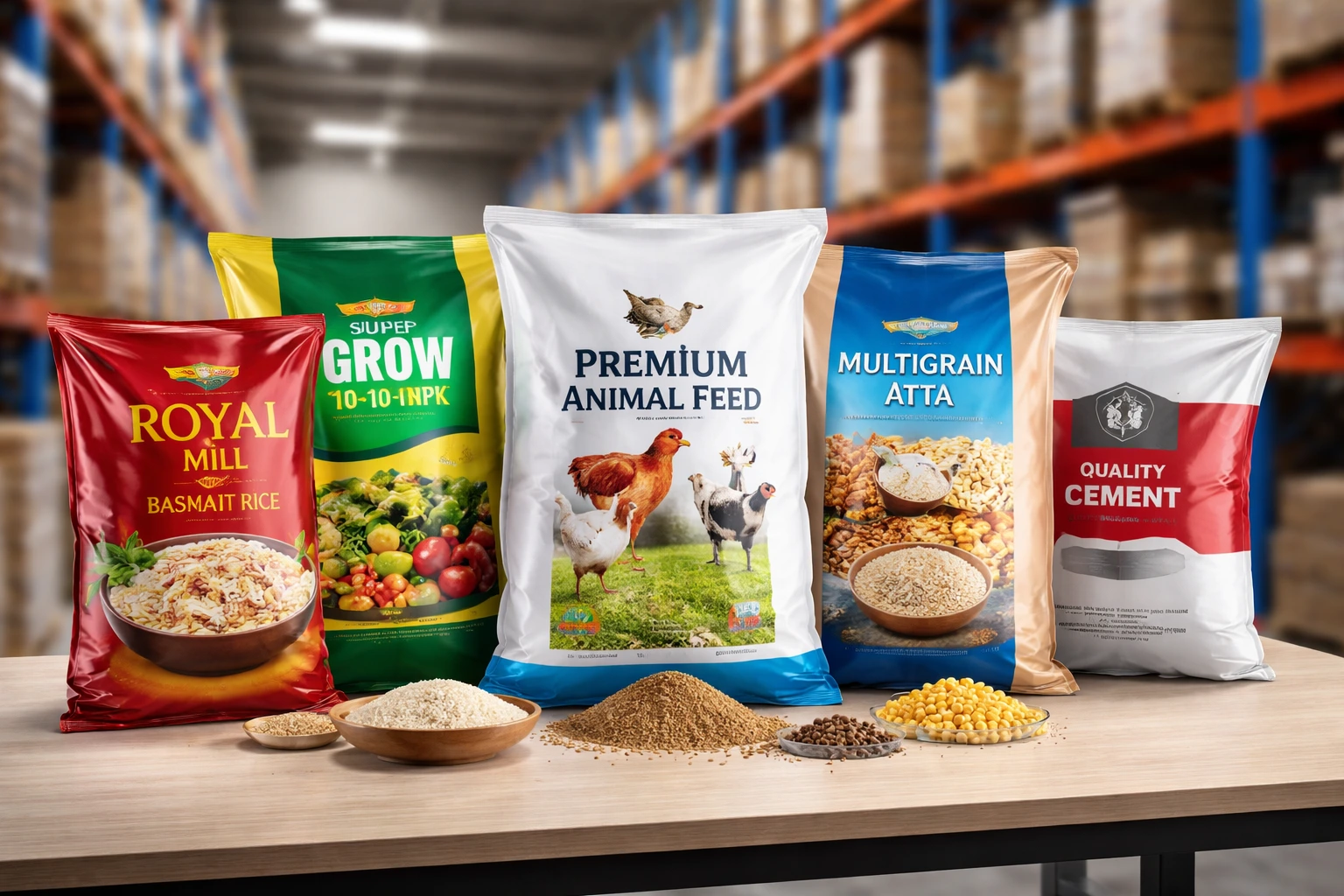
Sah Polymers’ high-quality industrial packaging bags are engineered to meet a wide range of application-specific requirements – from 10 kg retail food bags with BOPP lamination and high-gloss branding, to 1-tonne FIBCs for chemical or construction material handling. The ability to customise from the outset saves businesses significant time and cost over the supply relationship.
Critical customisation capabilities to assess in a prospective supplier include:
- Bag dimensions and GSM – the ability to produce bags precisely sized and weighted for your specific product
- Lamination options – plain, BOPP laminated, UV-stabilised, and moisture-resistant variants for different applications
- Printing – multi-colour flexographic or rotogravure printing, BOPP surface printing for premium retail bags
- Closure and access configurations – heat-sealed, sewn, valve-top, or open-mouth depending on filling machinery compatibility
- Inner liner options – PE or woven inner liners for moisture-sensitive or hygroscopic products
- Handle and carry options – strap handles, die-cut handles, or reinforced lift points for consumer-facing retail bags
✕ MISTAKE 5
Underestimating Sustainability and Compliance Requirements – Is Your Supplier EPR-Ready?
Why Is Packaging Compliance Non-Negotiable for Indian Businesses and Exporters in 2026?
Industrial Packaging Bags Supplier compliance obligations have expanded significantly in 2026 and will continue to tighten over the next three to five years. India’s Plastic Waste Management Rules 2022 mandate Extended Producer Responsibility (EPR) registration for all businesses that manufacture, import, or place plastic packaging on the Indian market. Failure to comply carries financial penalties and – in serious cases – restrictions on business operations.
For export-oriented businesses, the compliance stakes are even higher. The European Union’s Packaging and Packaging Waste Regulation (PPWR), which came into full effect in 2025, imposes strict recyclability, recycled content, and labelling requirements on packaging entering the EU market. UK and GCC markets have similarly tightened their import packaging compliance standards.
A supplier who is not proactively engaged with sustainability and compliance will leave your business exposed to:
- EPR penalty notices from the Central Pollution Control Board (CPCB) for non-registered plastic packaging
- Export rejections or customs delays due to non-compliant packaging labels or materials
- Loss of buyer contracts from international clients who audit supplier environmental compliance
- Reputational damage with retail chains and e-commerce platforms that now mandate recyclable packaging disclosures
At Sah Polymers, we actively support clients with EPR registration guidance, recyclability labelling requirements, and sustainable material options – including bags manufactured with recycled PP content where specifications allow. Choosing a packaging partner who is ahead of the compliance curve protects your business today and future-proofs your supply chain for the regulatory environment of tomorrow.
✕ MISTAKE 6
Failing to Evaluate Supply Chain Reliability – What Happens When Your Supplier Cannot Deliver?
Industrial Packaging Bags Supplier reliability is the factor that matters most when everything else is under pressure. A supplier who performs well in normal conditions but fails during peak demand periods, raw material price spikes, or logistics disruptions is a liability disguised as a partner. India’s packaging supply chains were severely tested in 2021–22 by global PP resin shortages, and again in 2023–24 by freight disruptions affecting export markets – experiences that exposed the vulnerability of businesses dependent on unreliable or single-source suppliers.
According to a 2026 logistics sector study by the Confederation of Indian Industry (CII), packaging supply chain disruptions were among the top five causes of production stoppages reported by Indian manufacturers – ahead of raw material shortages, labour issues, and equipment failures. The common thread in most cases was over-dependence on a single supplier without assessed contingency planning.
Key supply chain reliability indicators to assess before committing to a supplier include:
- On-time delivery track record – ask for verified references from current clients, not just testimonials on the supplier’s website
- Raw material procurement strategy – does the supplier maintain a buffer stock of PP granules to protect against spot market disruptions?
- Geographic logistics reach – can the supplier deliver reliably to your manufacturing locations, warehouses, and port of export?
- Communication responsiveness – how quickly does the supplier respond to queries, and is there a dedicated account manager for your account?
- Contingency capacity – does the supplier have arrangements to scale or redirect production if a key machine goes down?
According to Sah Polymers’ 2026 India market insights, clients with long-term supply agreements report significantly fewer production disruptions than those who operate on a spot-order basis. A well-structured supply partnership – with agreed lead times, buffer stock arrangements, and transparent communication protocols – eliminates most of the supply chain risk that businesses mistakenly accept as unavoidable.
People Also Ask: Industrial Packaging Bags Supplier – Quick Answers
| Q: What should I look for in an industrial packaging bags supplier in India?
Look for BIS and ISO certifications, proven production capacity, food-grade compliance (if applicable), multi-format customisation capabilities, EPR compliance readiness, verified on-time delivery track record, and transparent quality control documentation. Always test samples under real operating conditions before placing a bulk order. |
| Q: Why is quality certification important when choosing a packaging supplier?
Certifications such as BIS, ISO 9001:2015, and FSSAI compliance provide independent verification that a supplier’s materials, processes, and outputs consistently meet defined standards. For export markets, certification documentation is often a contractual requirement from international buyers and is essential for clearing customs in the EU, UK, and GCC regions. |
| Q: How do I ensure my packaging supplier can handle bulk orders during peak season?
Ask for verified monthly production capacity figures, visit the manufacturing facility (or request a virtual tour), assess the supplier’s raw material buffer stock strategy, and check references specifically from clients who have ordered during high-demand periods such as harvest season or retail peak quarters. |
| Q: What are EPR compliance requirements for packaging suppliers in India?
Under India’s Plastic Waste Management Rules 2022, all businesses manufacturing or using plastic packaging must register under the Extended Producer Responsibility (EPR) framework with the Central Pollution Control Board (CPCB). Registered businesses must meet annual recycling targets and ensure their packaging carries correct recyclability labelling. |
| Q: Can industrial packaging bags be customised for food-grade applications?
Yes. Reputable suppliers manufacture food-grade PP woven bags and BOPP laminated bags using food-safe PP resin and non-toxic inks, compliant with FSSAI guidelines. Customisation options include specific GSM weights, bag dimensions, inner liners, multi-colour printing, and closure configurations designed for compatibility with filling machinery. |
| Q: How does choosing the wrong packaging supplier affect export business?
A wrong supplier choice can result in consignment rejections due to non-compliant or failed packaging, financial penalties for repackaging and return freight, damaged goods, loss of buyer contracts, and reputational harm in target export markets. For Indian exporters, the cost of a packaging failure in markets like the EU, UK, or GCC can far exceed any savings made on packaging procurement. |
Conclusion: Make Your Industrial Packaging Bags Supplier Selection a Strategic Decision
Industrial Packaging Bags Supplier selection deserves the same strategic rigour as any other critical procurement decision your business makes. In 2026, packaging is not just a cost line – it is a quality signal, a compliance instrument, a brand vehicle, and a supply chain risk factor all in one. The six mistakes outlined in this article are avoidable with the right evaluation process, the right questions, and the right commitment to looking beyond the initial quote.
The businesses that thrive in India’s increasingly competitive manufacturing and export landscape are those that treat their packaging supplier as a genuine long-term partner – one who understands their products, their markets, and their operational realities, and who invests in the relationship accordingly.
At Sah Polymers, we bring together certified quality, high-volume production capacity, full-spectrum customisation, and a proven track record of reliable supply to manufacturers, exporters, distributors, and retailers across India and international markets. We do not just supply bags – we help our clients build packaging supply chains they can depend on.
Ready to evaluate a packaging partner who gets it right on every dimension that matters? Connect with the Sah Polymers team today to discuss your requirements, request samples, and discover why India’s most demanding businesses trust us with their industrial packaging needs.