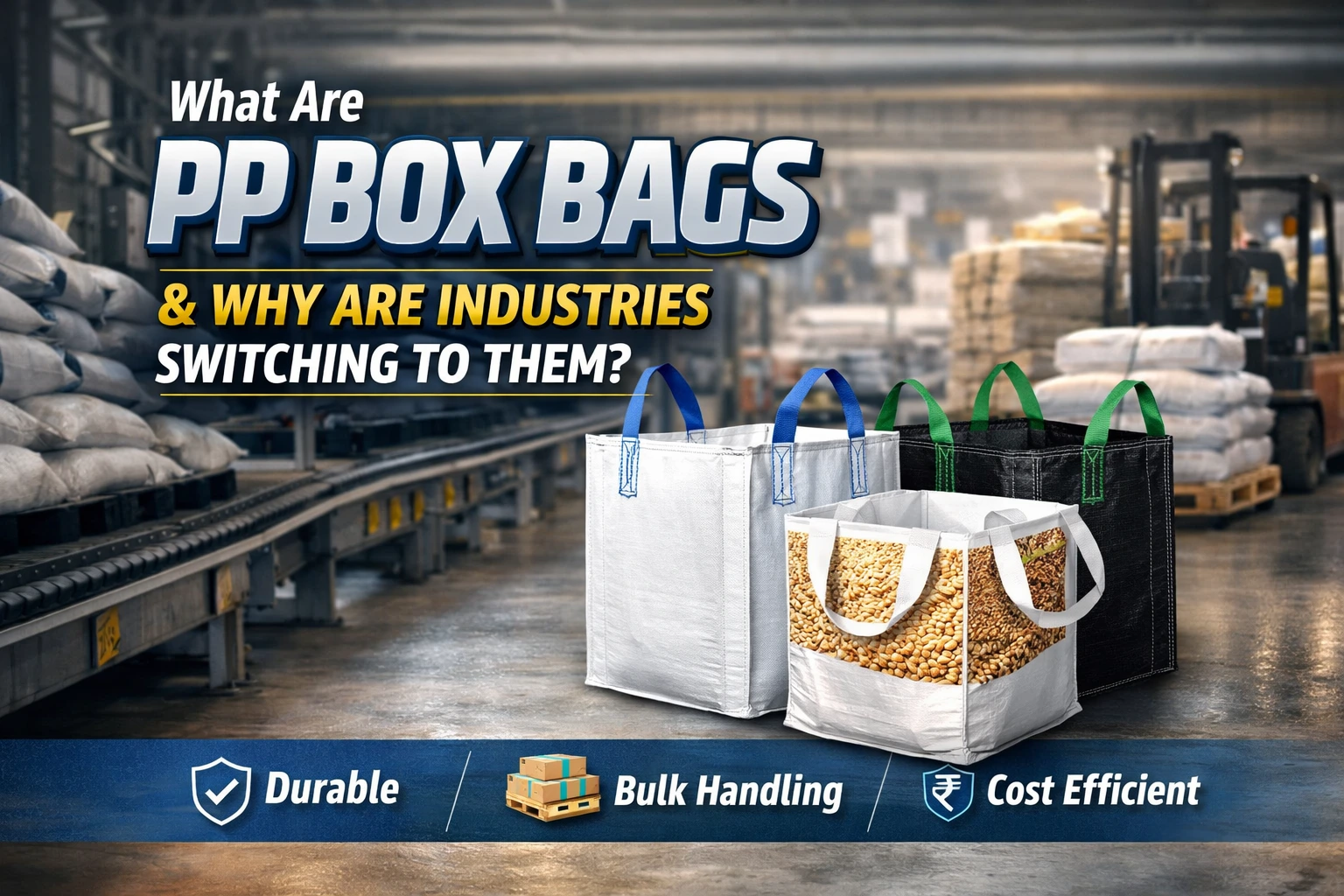
PP Box Bags are rapidly becoming one of the most talked-about packaging formats across India’s manufacturing, retail, and export sectors in 2026. While conventional PP woven bags have served industries for decades, a growing number of businesses are making a deliberate shift to the square-bottom, block-base design of PP box bags — drawn by the format’s superior stacking characteristics, cleaner retail presentation, and more efficient use of warehouse and shelf space. The question is no longer whether PP box bags are better for certain applications; it is whether your business can afford to keep packaging without them.
India’s packaging industry is on an accelerating growth curve, projected to cross ₹1.2 lakh crore in total value by end of 2026 (IFPMA, 2026). Within this landscape, the shift towards structured, premium-format woven packaging is one of the clearest trends emerging from both domestic retail expansion and rising international buyer expectations. Businesses sourcing high-quality PP box bags from Sah Polymers are discovering that the format delivers advantages that traditional flat-bottom or pillow-style PP bags simply cannot match — from more stable stacking on retail shelves to more efficient container loading for export shipments.
At Sah Polymers, we manufacture PP box bags for a wide range of industries — including food processing, agrochemicals, construction materials, retail FMCG, and industrial supply chains. In this article, we explain exactly what PP box bags are, how they differ from conventional PP woven bags, which industries are switching to them and why, and what to look for when choosing a manufacturer capable of delivering this format at scale and quality.
Table of Contents
ToggleWhat Exactly Is a PP Box Bag and How Does It Differ from a Standard PP Woven Bag?
PP Box Bags — also widely referred to as square-bottom bags, block-bottom bags, or flat-base woven bags — are a variant of the standard polypropylene woven sack engineered to stand upright independently on a flat base. Unlike conventional PP woven bags, which form a pillow or irregular shape when filled, a PP box bag maintains a defined rectangular geometry with four flat sides, a flat base, and a flat top closure.
This structural difference is achieved through a combination of gusseted side panels and a specially constructed, reinforced square base. When filled, the bag retains its box-like form — enabling it to stand upright without support, stack cleanly and stably with the bags above and below it, and occupy a defined, predictable footprint in storage, transit, and retail display.
| Feature | Standard PP Woven Bag | PP Box Bag |
| Base shape | Rounded / pillow when filled | Flat, square, self-standing |
| Stackability | Unstable — bags lean and shift | Stable — bags stack evenly and securely |
| Retail shelf presence | Unstructured appearance | Clean, box-like, premium presentation |
| Space efficiency | Irregular — wasted space between bags | Rectangular — maximises pallet and shelf density |
| Branding surface | Curved, limited print area when filled | Flat panels — four full sides for branding |
| Consumer handling | Awkward to grip and carry when full | Ergonomic — easier to handle and pour from |
The result is a packaging format that behaves more like a rigid carton or box in its functional profile — with the cost efficiency, strength, and versatility of polypropylene woven construction. This combination has made PP box bags the preferred choice for a growing range of applications across Indian industry and export markets.
Which Industries in India Are Switching to PP Box Bags — and Why?
What Sectors Are Driving PP Box Bag Adoption in India in 2026?
PP Box Bags adoption is accelerating across multiple sectors in India, driven by a convergence of factors: the rapid expansion of organised retail, rising international buyer expectations for structured packaging, increasing warehouse automation, and the shift of Indian exporters towards premium-presentation formats that distinguish their products in global markets.
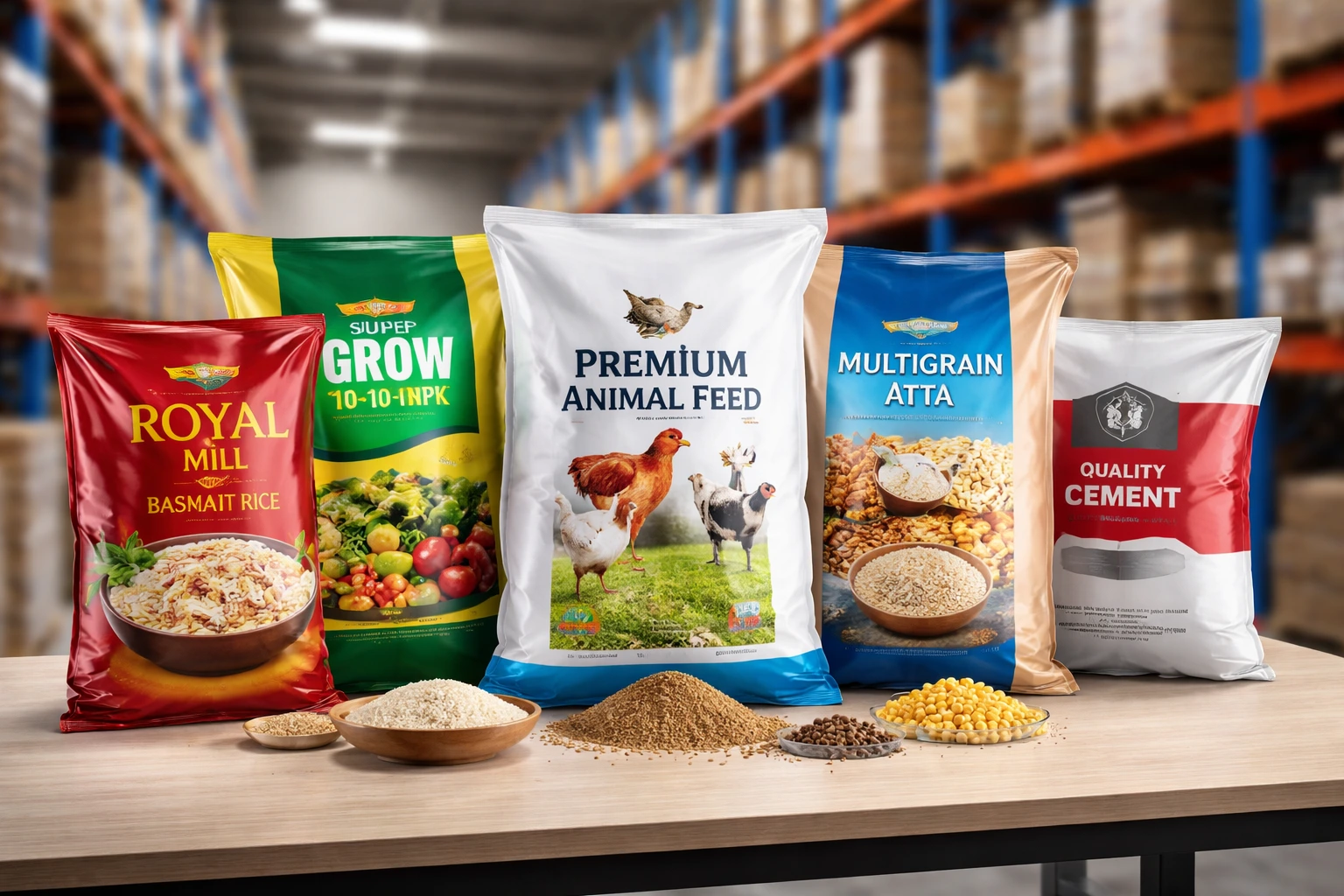
The industries leading the switch to PP box bags in 2026 include:
- Food processing and agri-commodities — rice, flour, sugar, pulses, and spices brands are among the most active adopters of PP box bags. The format’s flat base and four-panel print surface make it ideal for modern trade environments — supermarkets, hypermarkets, and cash-and-carry stores — where products are displayed standing upright and packaging presentation directly influences purchase decisions.
- Agrochemicals and fertilisers — structured, self-standing packaging reduces the risk of bag puncture and spillage during handling, an important safety and compliance consideration for chemical products. The stable base also allows safer stacking in warehouse environments where forklift and pallet handling is the norm.
- Construction materials — cement, gypsum, tile adhesive, and dry-mix construction product manufacturers are switching to PP box bags for the improved stacking stability they provide on pallets, in container loads, and at point-of-sale in hardware retail environments.
- Animal feed and pet food — the pet food sector in India is one of the fastest-growing FMCG segments, with the market projected to grow at 16% CAGR through 2026–2028 (Statista India, 2026). Premium animal feed and pet food brands require packaging that aligns with the premium positioning of the product — and PP box bags deliver the structured, brand-forward presentation that this category demands.
- Retail FMCG and consumer goods — salt, detergent powder, cooking medium, and other household staples are increasingly packed in PP box bags for organised retail, where shelf space management and planogram compliance require consistent, defined bag footprints.
- Export packaging — Indian exporters across categories are adopting PP box bags to meet the presentation standards of international buyers in the EU, UK, GCC, and Southeast Asia, where structured, stable packaging is the expected norm in organised import retail.
What Are the Key Structural and Functional Advantages of PP Box Bags?
PP Box Bags deliver a distinct set of functional advantages that make them the superior packaging choice for products destined for organised retail, mechanised warehouse environments, and export markets. These advantages are not merely aesthetic — they translate into measurable operational and commercial benefits for businesses that make the switch.
The core structural and functional benefits of PP box bags include:
- Independent standing — a filled PP box bag stands upright without any external support. This eliminates the need for display frames, shelf dividers, or additional structural packaging, reducing display setup time and costs for retail clients.
- Superior stacking stability — the flat base and consistent rectangular geometry enable bags to stack in perfectly aligned columns, reducing the risk of stack collapse, damaged goods, and workplace safety incidents in warehouses and during container loading.
- Maximum space utilisation — the rectangular form of PP box bags eliminates the wasted interstitial space that accumulates when pillow-shaped bags are stacked or loaded into containers. This can increase usable pallet and container space by 10–18%, with direct implications for freight cost per unit on export shipments.
- Four-panel branding surface — when filled and standing, a PP box bag presents four flat, printable panels to the consumer or buyer — front, back, and two sides. This dramatically increases the available brand real estate compared to conventional bag formats, enabling richer brand storytelling, multilingual compliance text, and product imagery across all four faces.
- Better consumer ergonomics — the box shape makes PP bags easier to grip, carry, pour from, and store in a consumer’s home or workplace. This functional superiority supports premium brand positioning and consumer satisfaction — both critical for repeat purchase in food and FMCG categories.
- Reduced in-store and warehouse damage — the stable, self-standing form reduces the likelihood of bags being knocked over, pierced by adjacent packaging, or damaged through uneven stacking pressure — decreasing wastage rates and the associated costs of product loss and repackaging.
According to Sah Polymers’ 2026 India market insights, clients who transition from conventional PP woven bags to PP box bags for retail and export applications report average improvements in pallet density of 12–15%, measurable reductions in in-transit damage rates, and consistently positive feedback from retail buyers and international import agents on packaging presentation quality.
How Do PP Box Bags Enhance Brand Identity for Indian Manufacturers and Exporters?
PP Box Bags are not just a structural upgrade — they are a branding platform. The transition from a rounded, pillow-style woven bag to a flat-panel, self-standing box bag fundamentally changes what is possible in terms of packaging design and brand communication. For Indian businesses competing in organised retail and export markets, this design advantage is one of the most compelling arguments for making the switch.
The four flat panels of a filled PP box bag create a 360-degree canvas that brands can use strategically:
- Front panel — primary brand identity: logo, product name, hero imagery, and key product claims in the highest-impact position for retail shelf visibility.
- Back panel — extended product information: ingredients, nutritional data, usage instructions, certifications, and barcode or QR code placement for retail compliance.
- Side panels — supplementary brand messaging: recipe suggestions, brand story, product range cross-sells, or export compliance text for international markets.
- Base panel — often used for batch codes, manufacturing date, and traceability information — increasingly important for food safety compliance and supply chain transparency.
When combined with BOPP lamination — which applies a high-quality polypropylene film to the bag surface — PP box bags achieve photographic-quality print resolution across all four panels. The resulting packaging rivals flexible stand-up pouches in visual impact, at a significantly lower material cost per kilogram of product packed.
Sah Polymers’ high-quality PP box bags are available with BOPP lamination, multi-colour flexographic printing, UV-stabilisation, and a range of closure configurations — enabling Indian brands to achieve the premium retail presentation of leading international packaging formats, manufactured cost-efficiently in India for domestic and export markets.
Are PP Box Bags Suitable for Food-Grade, Export, and Sustainable Packaging Applications?
How Do PP Box Bags Meet Food Safety and International Export Standards?
PP Box Bags manufactured with food-safe polypropylene resin and non-toxic printing inks are fully compliant with FSSAI food contact material requirements in India. This makes them suitable for direct-contact packaging of a wide range of food products — including rice, flour, sugar, pulses, salt, spices, and animal feed — across both domestic retail and export supply chains.
For Indian exporters, PP box bags offer a packaging format that simultaneously meets the structural requirements of international shipping and the presentation standards of organised import retail in target markets. Key export compliance advantages include:
- Stable stacking for container loading — the rectangular form maximises container utilisation and minimises movement during ocean freight, reducing in-transit product damage.
- BOPP lamination moisture barrier — protects hygroscopic food products from humidity during long ocean freight journeys through tropical shipping lanes.
- Multilingual print capability — all four panels can carry regulatory text in the language requirements of destination markets, supporting smooth customs clearance.
- Food-grade material certification — exporters can obtain material safety documentation from Sah Polymers to satisfy import authority requirements in the EU, UK, GCC, and Southeast Asian markets.
On sustainability, PP box bags share the environmental profile of standard PP woven bags — polypropylene is 100% recyclable within PP waste streams, and the box bag format’s improved space efficiency reduces carbon emissions per unit shipped by enabling denser container and pallet loading. Under India’s Plastic Waste Management Rules 2022, businesses using PP box bags must register under the Extended Producer Responsibility (EPR) framework and ensure correct recyclability labelling — an area where Sah Polymers actively supports its clients.
How Does Sah Polymers Manufacture PP Box Bags for India and Global Markets?
PP Box Bags require more precision in manufacture than standard PP woven sacks. The gusseted side panels and reinforced square base must be constructed with consistent geometry across every bag in a production run — because an inconsistent base or irregular gusset will compromise the self-standing properties and stacking stability that define the format’s value proposition.
At Sah Polymers, we manufacture PP box bags with the same commitment to precision and consistency that we bring to every product in our range. Our production capabilities for PP box bags include:
- Custom dimensions and GSM — bags engineered to specific load capacities, product weights, and storage or display requirements, with GSM specifications tailored to application demands.
- Reinforced square base construction — consistent gusseting and base formation across the production run, ensuring every bag stands upright and stacks uniformly.
- BOPP and non-laminated options — standard PP box bags for industrial applications, and BOPP laminated variants with high-resolution multi-colour printing for retail and export markets.
- Flexible closure configurations — sewn open-mouth, heat-sealed, valve-top, and zip-lock closure options to suit different filling machinery and consumer-use requirements.
- Inner liner compatibility — PE inner liners available for moisture-sensitive or hygroscopic products requiring an additional barrier within the box bag structure.
- Food-grade material compliance — all food-contact PP box bags manufactured using virgin food-safe PP resin and non-toxic inks, with supporting material safety documentation available for export compliance.
According to Sah Polymers’ 2026 India market insights, the demand for PP box bags has grown significantly year-on-year across our client base — driven primarily by the food processing, retail FMCG, and agri-export sectors. We work closely with clients from the specification stage to ensure that the bag design, print artwork, and structural configuration are optimised for their specific product, filling process, and distribution environment — before a single production run begins.
People Also Ask: PP Box Bags — Quick Answers
| Q: What is a PP box bag and how is it different from a regular PP woven bag?
A PP box bag — also called a square-bottom or block-bottom woven bag — is a polypropylene woven sack engineered with a flat, reinforced base and gusseted side panels. When filled, it maintains a rigid, box-like rectangular shape that allows it to stand upright independently, stack stably, and present four flat printable panels. A regular PP woven bag forms a pillow or rounded shape when filled and cannot stand upright without support. |
| Q: Which industries use PP box bags in India?
PP box bags are used across food processing (rice, flour, sugar, pulses), retail FMCG (salt, detergent, cooking medium), agrochemicals and fertilisers, construction materials (cement, dry-mix products), animal feed and pet food, and export packaging. Any industry where stable stacking, shelf presentation, or space efficiency is a priority benefits from the PP box bag format. |
| Q: Are PP box bags food-safe and suitable for export markets?
Yes. PP box bags manufactured with food-grade polypropylene resin and non-toxic inks are FSSAI-compliant in India and suitable for food-contact applications. For export markets, they can be produced with supporting material safety documentation to satisfy import authority requirements in the EU, UK, GCC, and Southeast Asia. |
| Q: Can PP box bags be customised with branding and multi-colour printing?
Yes. PP box bags offer four flat panels when filled, providing a full 360-degree branding surface. With BOPP lamination and multi-colour flexographic or rotogravure printing, all four panels can carry high-resolution brand imagery, product information, regulatory text, barcodes, and QR codes — delivering a premium retail presentation equivalent to flexible stand-up pouches. |
| Q: How do PP box bags improve container and warehouse space efficiency?
The rectangular, flat-base geometry of PP box bags eliminates the wasted interstitial space that accumulates between pillow-shaped conventional bags. When palletised or loaded into containers, PP box bags can increase usable space utilisation by 10–18%, reducing freight cost per unit and improving the efficiency of warehouse storage — a significant operational advantage for high-volume manufacturers and exporters. |
| Q: Are PP box bags recyclable and EPR-compliant in India?
Yes. PP box bags are made from polypropylene, which is 100% recyclable within PP waste streams. Under India’s Plastic Waste Management Rules 2022, businesses using PP box bags must register under the Extended Producer Responsibility (EPR) framework with the Central Pollution Control Board (CPCB), meet annual recycling targets, and ensure bags carry appropriate recyclability labelling. |
Conclusion: Is It Time for Your Business to Switch to PP Box Bags?
PP Box Bags represent one of the most significant functional and commercial upgrades available to Indian manufacturers, exporters, and retailers in 2026 — combining the industrial strength and cost efficiency of polypropylene woven construction with the structured form, stacking stability, and 360-degree branding capability that modern retail and international export markets demand.
The industries switching to PP box bags are not doing so as a cosmetic exercise. They are responding to the measurable advantages the format delivers: better space utilisation in containers and warehouses, reduced in-transit damage, stronger retail shelf presence, and the ability to communicate brand identity across four full panels rather than a single curved surface. As organised retail grows its share of India’s FMCG distribution, and as international buyers continue to raise their packaging standards, the case for PP box bags will only strengthen.
Whether you are a rice miller targeting premium domestic retail, an agrochemical manufacturer looking for safer warehouse stacking, an animal feed brand competing in India’s fast-growing pet food market, or an exporter building a premium-presentation product range for international buyers — PP box bags from Sah Polymers offer the format, the quality, and the customisation capability your business needs.
Connect with the Sah Polymers team today to request samples, discuss your specific application requirements, and discover why India’s most ambitious manufacturers and exporters are choosing PP box bags as their packaging format of choice for 2026 and beyond.